.png)


Team Petpitch India
14 Sept 2026
West India Pet Industry 2026 Market Leadership Structural Dynamics and Strategic Opportunities in Indias Largest Regional Pet Economy
Market Landscape | Consumer Trends | Veterinary Infrastructure | Product Opportunity | Startup Strategy | 2026–2031 Outlook
Executive Summary

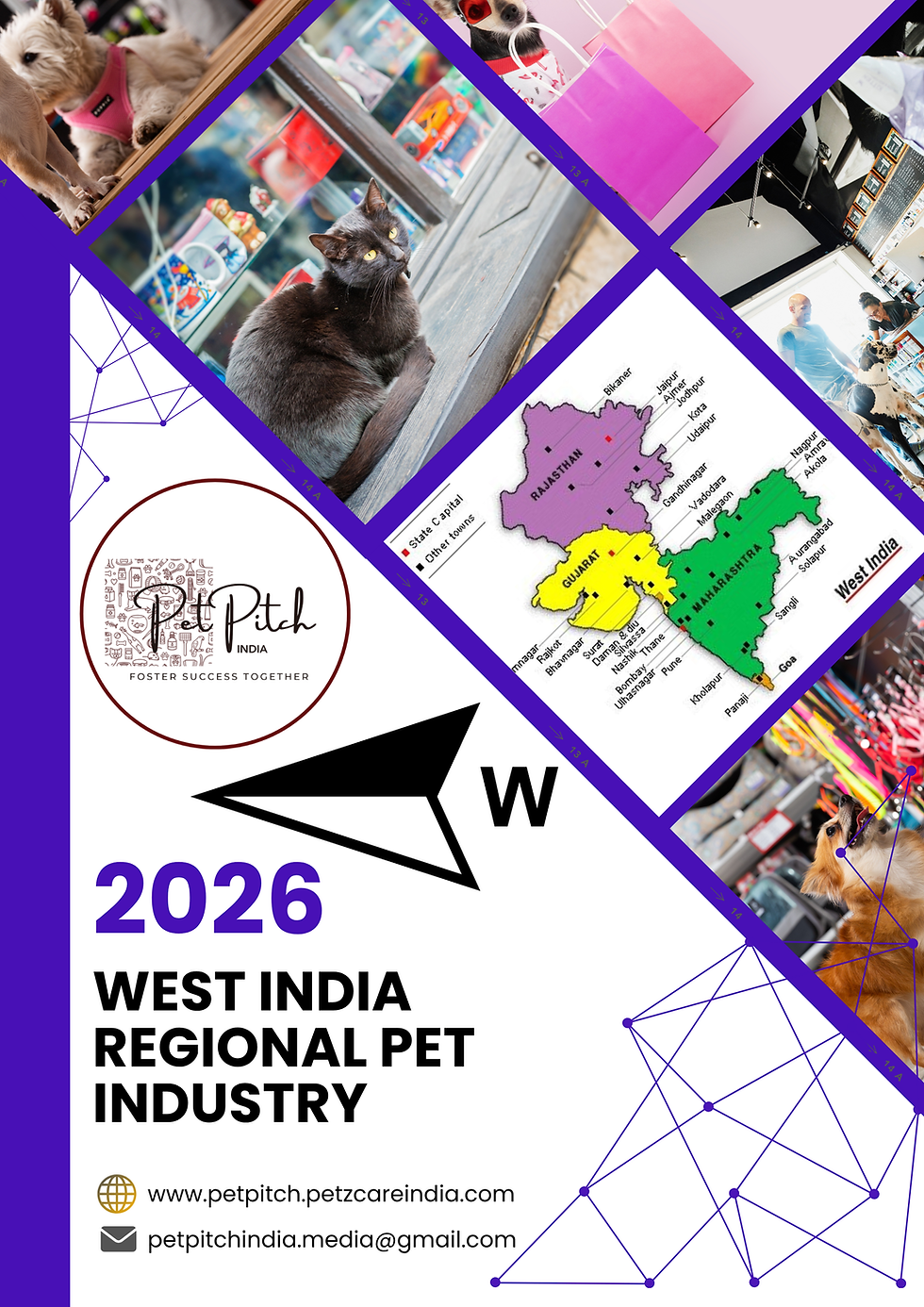
West India is emerging as one of India's most commercially attractive pet-care regions, driven primarily by Mumbai, Pune, Ahmedabad and other urban centres across Maharashtra and Gujarat, with Goa and Rajasthan adding important tourism, lifestyle and premium-consumption markets. For the purpose of this report, West India is considered primarily as Maharashtra, Gujarat, Goa and Rajasthan, while recognising that some industry reports classify Rajasthan differently.
One recent market estimate places West India at approximately 34% of India's pet-food market in 2025, making it the country's leading regional market. The same analysis identifies Mumbai and Pune as the principal engines, supported by higher disposable incomes, nuclear households, organised retail and increasing pet-friendly housing.
The broader Indian market provides a strong backdrop. India's pet population reached approximately 39.2 million in 2025, including 33.4 million dogs and 4.5 million cats. The overall pet population grew at 6.6% annually between 2020 and 2025 and is forecast to reach approximately 51.8 million by 2030.
West India's opportunity is particularly interesting because it combines affluence with digital adoption. Mumbai and Pune provide a mature premium consumer base; Ahmedabad and Surat offer expanding middle-class markets; Nashik and Nagpur create additional Maharashtra opportunities; Jaipur represents an important lifestyle market; and Goa offers a distinctive premium, tourism-linked and expatriate-influenced consumer segment.
For startups, the strategic opportunity is not simply to sell pet food. It is to build a regional pet-care brand around nutrition, trust, convenience and recurring consumption.
1.Why West India Matters
West India has several structural advantages over emerging regions.
First is purchasing power. Mumbai and Pune have large concentrations of professionals, entrepreneurs and dual-income households.
Second is urban housing. Apartment living and nuclear families have created conditions in which dogs and cats increasingly become companions rather than working animals.
Third is digital commerce. The Indian pet-food market generated approximately US$769.7 million in retail sales in 2025, growing 16.6% annually from 2020. E-commerce represented approximately 31.6% of pet-food distribution, while pet shops and superstores accounted for 42.6%.
This creates a particularly attractive environment for a startup because the company does not need to build a large physical retail network before reaching consumers.
West India also has considerable veterinary infrastructure. As of March 2024, Maharashtra had 351 veterinary hospitals/polyclinics and 4,439 dispensaries, Gujarat had 34 hospitals and 929 dispensaries, Rajasthan had 3,163 hospitals and 7,863 dispensaries, while Goa had five hospitals and 25 dispensaries.
These are overall veterinary institutions and are not equivalent to companion-animal clinics, but they demonstrate the scale of animal-health infrastructure across the region.
2.The Main Markets
Mumbai: India's Premium Pet-Care Capital
Mumbai should be the first market on the list for any startup entering West India.
The city has a mature ecosystem covering pet food, grooming, veterinary care, boarding, training, accessories and premium lifestyle products.
The arrival of the Tata Trusts Small Animal Hospital at Mahalaxmi has further strengthened the city's high-end veterinary ecosystem. Tata Trusts describes it as a specialised facility focused on the care, cure and comfort of animals.
Mumbai's retail ecosystem ranges from independent neighbourhood stores to premium organised chains. Current market listings, for example, include Heads Up For Tails Pet Store & Spa - Colaba, Mumbai, Heads Up For Tails Pet Store & Spa - Prabhadevi, Mumbai, Heads Up For Tails Pet Store - Jio World Drive, Mumbai and independent operators such as Mumbai Pet Shop. "Just Dogs" is another Retail store offering products and services under one roof.
The significance is not simply the number of stores. Mumbai's pet parent is increasingly comfortable purchasing premium food, wet food, functional treats, supplements and veterinary diets.
For a startup, Mumbai should be the brand-building and premiumisation laboratory.
3.Pune: The Startup-Friendly Pet Market
Pune is arguably the most strategically interesting secondary market in West India.
The city combines a large young professional population, IT and services employment, extensive apartment communities and a strong culture of digital purchasing.
Organised pet retail is already visible across neighbourhoods such as Kalyani Nagar, Aundh, Baner, Magarpatta and Koregaon Park. Examples include JUSTDOGS | Kalyani Nagar, Pune - Pet Store & Spa, Heads Up For Tails Pet Store & Spa - Kalyani Nagar, Pune, Heads Up For Tails Pet Store & Spa - Magarpatta, Pune and Pets Spot - The One Stop Pet Shop, Koregaon Park.
Pune is particularly suited to D2C brands, subscriptions, premium nutrition, and pet-tech.
It is also an ideal market for testing products with Millennials and Gen Z before expanding into more price-sensitive cities.
4.Ahmedabad and Gujarat: The Next Major Growth Cluster
Ahmedabad is an important emerging market for organised pet care.
Gujarat's opportunity extends beyond Ahmedabad to Surat, Vadodara and Rajkot. The state has a large urban population, strong business communities and improving access to organised retail.
Unlike Mumbai, the Gujarat opportunity is likely to require a more balanced price architecture.
The strongest proposition may therefore be accessible premiumisation: products that provide better ingredients and nutritional positioning without entering the highest premium price band.
For startups, Ahmedabad can serve as a regional distribution hub, with Surat and Vadodara following as expansion markets.
5.Rajasthan: Jaipur as a Regional Gateway
Jaipur provides a different type of opportunity.
The city's tourism economy, growing middle class and increasing exposure to lifestyle-oriented pet care make it strategically relevant. Rajasthan's enormous veterinary network—more than 11,000 veterinary institutions when hospitals, dispensaries and aid centres are combined in the 2024 data—also indicates the scale of animal-health infrastructure across the state.
The commercial challenge is affordability.
A startup should therefore avoid entering Jaipur with only ultra-premium products.
A better strategy would be:
Mid-premium kibble + affordable wet food + treats + supplements + selective premium products.
Jaipur can eventually become a gateway to Udaipur, Jodhpur, Kota and other urban markets.
6. Goa: A Small but Distinctive Market
Goa is not a volume market comparable to Maharashtra or Gujarat.
Its importance lies elsewhere.
Goa has a strong lifestyle economy, significant tourism, a high visibility of community and adopted dogs, and a consumer base that includes professionals, expatriates and long-term visitors.
This creates opportunities for:
Premium food
Natural products
Fresh food
Treats
Grooming
Boarding
Travel products
Pet-friendly hospitality
A startup should treat Goa as a premium niche market and brand showcase, rather than a mass-volume market.

7. Dogs Will Drive Volume; Cats Will Drive Category Growth
Dogs continue to dominate India's pet economy.
In 2025, dogs represented approximately 33.4 million of India's 39.2 million pets, or about 85% of the population.
The commercial opportunity remains enormous.
India's dog-food retail market reached approximately US$540.1 million in 2025, accounting for about 70% of pet-food sales. Dog food grew at approximately 13% CAGR between 2020 and 2025.
But cats are changing the market's growth profile.
India's cat population reached approximately 4.5 million in 2025, up from 2.4 million in 2020, representing 13.6% annual growth. Cat-food retail sales reached US$213.9 million in 2025, growing at 31.1% CAGR over 2020–25.
For West India this is particularly important because Mumbai and Pune have large numbers of apartment-based, digitally active younger consumers.
The strategic equation is:
Dogs = Scale
Cats = Growth
8. Kibble: The Foundation of the Portfolio
Dry food remains the largest commercial pet-food format.
In 2025, dry dog food alone generated approximately US$408.5 million in Indian retail sales. Economy dry dog food represented US$302.2 million, demonstrating that affordability remains critical even as premiumisation increases.
A startup entering West India should therefore avoid positioning itself exclusively around premium wet or fresh food.
Recommended Dog Kibble SKUs
Launch phase:
Puppy Small/Medium Breed
Adult Small/Medium Breed
Adult Large Breed
Sensitive Digestion
Skin & Coat
Recommended Cat Kibble SKUs
Kitten
Adult
Sterilised/Indoor Cat
Digestive/Hairball
The startup should begin with 8–10 meaningful dry-food SKUs, rather than creating an unnecessarily large catalogue.
The goal should be to establish high repeat purchase before expanding.
9. Wet Food: The Premiumisation Engine
Wet food is where the category becomes particularly interesting.
Indian wet dog food sales increased from approximately US$29.3 million in 2020 to US$71 million in 2025, representing 19.4% CAGR.
Wet cat food performed even better, increasing from US$21 million to US$88.7 million over the same period, equivalent to 33.4% CAGR.
West India, particularly Mumbai and Pune, is therefore well positioned for this category.
Recommended wet-food products include:
Chicken gravy
Fish/tuna
Chicken & liver
Pâté
Kitten wet food
Sterilised-cat wet food
Dog meal toppers
Small single-serve packs are useful for customer acquisition.
The strategy should be:
Kibble creates the base relationship; wet food increases premiumisation, basket value and feeding frequency.
10. Raw and Fresh Food: A Premium Pilot
Raw food is attractive but should be approached carefully.
The principal challenges are:
Cold-chain logistics
Food safety
Storage
Nutritional completeness
Delivery economics
Consumer education
For a startup, the better proposition is complete fresh/frozen meals, rather than simply selling raw meat.
The initial target should be affluent urban clusters in:
Mumbai → Pune → Goa
A subscription model could offer:
7-day meal plans
14-day plans
Monthly plans
Fresh-food toppers
Mixed kibble + fresh plans
Fresh food should initially be a differentiator rather than the company's main revenue engine.

11. The Target Consumer: Gen Z and Millennials
West India's greatest startup advantage may be its younger digital consumer base.
Gen Z: The Discovery Generation
Gen Z is not necessarily loyal to established pet brands simply because they have been in the market for decades.
They discover products through:
Instagram → YouTube → creators → reviews → search → e-commerce/quick-commerce.
This is a significant advantage for startups.
A new company can compete for attention without having a national distribution network.
But Gen Z is also sceptical of advertising.
The message should therefore not be:
“We are India's premium pet-food brand.”
Instead:
“Know what you feed. Know why it matters.”
The content should demonstrate:
Ingredients
Nutritional purpose
Manufacturing
Feeding quantities
Product testing
Veterinarian opinions
Pet-parent experiences
Transparency becomes the marketing.
Millennials: The Wellness Buyer
Millennials are particularly important for premiumisation.
They are more likely to spend on:
Better-quality food
Wet food
Supplements
Veterinary diets
Grooming
Preventive healthcare
Subscriptions
The messaging should therefore focus on long-term wellbeing:
“Better nutrition for every stage of your pet's life.”
The startup should sell a relationship rather than a packet.
12. Digital Strategy for a West Indian Startup
1. Become a Nutrition Educator
The startup should create content answering real questions:
Is kibble enough?
Should cats eat wet food?
How much should my dog eat?
What is complete nutrition?
What does protein percentage actually mean?
How should I change food?
What should a sterilised cat eat?
How many treats are appropriate?
This creates both SEO visibility and brand authority.
City-Specific Content
Messaging should vary by market.
Mumbai: Premium nutrition and convenience
Pune: Wellness, subscriptions and digital-first pet parenting
Ahmedabad: Affordable premium nutrition
Surat: Convenience and accessible products
Jaipur: Quality nutrition at sensible pricing
Goa: Natural, fresh and lifestyle-oriented pet care
3. Micro-Influencers
Instead of spending heavily on celebrities, build a network of local:
Dog parents
Cat parents
Veterinarians
Trainers
Groomers
Pet photographers
Pet communities
The goal is not just reach.
It is trust + trial + review + repeat purchase.
4.WhatsApp Retention
Pet food is naturally suited to recurring commerce.
The digital journey should be:
Purchase → Feeding guide → Transition support → Usage reminder → Reorder reminder → Subscription
This can significantly improve customer lifetime value.
13. Offline Strategy: Trust Before Scale
Digital acquisition alone will not be sufficient.
Pet food is a trust-driven category, and veterinary professionals and specialty retailers remain important.
Veterinary Partnerships
The startup should create professional education programmes rather than simply giving sales incentives.
Veterinarians should understand:
Product formulation
Feeding guidelines
Ingredient rationale
Product positioning
Appropriate use cases
The veterinary sector itself has significant infrastructure in West India. Maharashtra alone recorded 351 veterinary hospitals/polyclinics and 4,439 dispensaries in the latest official institutional data.
Mumbai's specialised veterinary infrastructure is also expanding, illustrated by the Tata Trusts Small Animal Hospital.
Specialty Retail
The startup should initially target 100–200 high-potential stores, rather than attempting national distribution.
Retailers should receive:
Product training
Sampling support
Attractive margins
POS material
Consumer education
Sales incentives
Apartment Communities
Mumbai and Pune have thousands of dense residential communities.
A startup can conduct:
Pet Health Camp + Nutrition Consultation + Sampling + Digital Registration
The offline event then becomes a digital customer-acquisition funnel.
14. Recommended SKU Architecture
Category | Initial SKUs | Role |
Dog Kibble | 4–5 | Volume |
Cat Kibble | 2–3 | Growth |
Wet Cat Food | 2–3 | Premiumisation |
Wet Dog Food | 1–2 | Basket expansion |
Treats | 2 | Repeat/impulse |
Fresh/Raw | Pilot | Differentiation |
The startup should follow:
Launch → Test → Measure → Repeat → Expand.
Do not build a 30-SKU portfolio simply to appear large.
India's pet-food market already recorded 1,286 new product launches between 2020 and 2025, with annual launches rising from 151 in 2020 to 273 in 2025.
More products do not automatically create differentiation.
Better products do.
15. SWOT Analysis
Strengths | Weaknesses |
West India has strong urban purchasing power | Market concentrated heavily in major cities |
Mumbai and Pune have mature ecosystems | City-level pet population data remains fragmented |
Strong specialty retail | Premium products can be expensive |
High digital adoption | Competition from established brands |
Strong veterinary infrastructure | Fresh/raw logistics can be difficult |
Opportunities | Threats |
Rapid cat-food growth | Strong multinational brands |
Wet-food premiumisation | Price competition |
D2C and subscription models | Consumer distrust of claims |
Fresh-food innovation | Cold-chain costs |
Tier-2 expansion | Unorganised food products |
Veterinary partnerships | Regulatory and quality uncertainty |
16. Five-Year Potential: 2026–2031
The national outlook provides strong support for West India's opportunity.
India's pet population is expected to increase from approximately 39.2 million in 2025 to 51.8 million by 2030, while pet-food retail sales are forecast to rise from approximately US$769.7 million in 2025 to US$1.34 billion by 2030.
The next five years should therefore be viewed in phases.
2026–27: Establishment
Mumbai and Pune should remain the primary launch markets.
Focus:
Product-market fit + digital awareness + veterinary partnerships + specialty retail.
2028–29: Regional Expansion
Move into:
Ahmedabad → Surat → Vadodara → Nashik → Nagpur → Jaipur
Build distributor relationships while maintaining D2C.
2030–31: Category Expansion
The strongest brands will increasingly move beyond basic food into:
Functional nutrition
Supplements
Veterinary diets
Fresh food
Personalised nutrition
Subscriptions
Pet health technology
The winning companies will become pet-care ecosystems rather than single-product brands.
17. The West India Startup Playbook
A startup entering West India should follow a relatively simple sequence.
Phase 1 — Mumbai
Build the brand, test pricing and acquire premium customers.
Phase 2 — Pune
Test subscriptions, digital acquisition and younger consumers.
Phase 3 — Ahmedabad
Introduce accessible premium products and build regional distribution.
Phase 4 — Jaipur, Surat, Vadodara and Nashik
Expand through a combination of distributors, specialty stores and e-commerce.
Phase 5 — Regional Ecosystem
Build recurring nutrition programmes connecting:
Food + Wellness + Veterinary Care + Digital + Community
Distribution Channels and Retail Landscape
West India's pet industry benefits from a multi-channel distribution system that combines traditional and modern trade with fast-growing digital platforms.
Offline Channels
Independent Pet Shops and Aquarium Stores:
Remain the backbone of pet retail, especially in neighbourhood markets across Mumbai, Pune, Ahmedabad, and Surat.
Often combined with grooming, basic vet services, and aquarium supplies, creating one-stop destinations for pet owners.
Veterinary Clinics and Hospitals:
Many vets retail pet food, supplements, and healthcare products directly to clients, leveraging trust and professional recommendations.
Prescription diets and therapeutic foods are primarily sold through veterinary channels.
Pet-Specialty Chains:
National and regional chains such as Heads Up For Tails, Supertails experience centres, JUSTDOGS, and Pets World have a strong presence in Mumbai and Pune, offering curated assortments, grooming, and advisory services.
Modern Trade:
Supermarkets and hypermarkets in major malls and high streets stock select pet food and accessory brands, though the range is often narrower than in specialty stores.
Online Channels
E-commerce is a critical growth driver, especially for premium and niche products:
Dedicated pet platforms: Supertails, JustDogs, Heads Up For Tails, Dogspot, and others offer wide SKUs, subscription models, and value-added services (vet chat, grooming bookings).
General marketplaces: Amazon, Flipkart, and quick-commerce apps (Blinkit, Zepto) are increasingly used for routine purchases of food, litter, and treats.
D2C brands: Numerous startups sell directly via websites, WhatsApp, and Instagram, targeting specific niches (natural food, breed-specific diets, homemade treats).
In West India, online spend share is higher than the national average, reflecting greater digital literacy, logistics infrastructure, and willingness to experiment with new brands. India's pet e-commerce market is projected to hit USD 500 million by 2025, though only about 15% of pet products are currently bought online, indicating significant headroom for growth.
Key Industry Players
West India hosts a mix of multinational corporations, large Indian manufacturers, and innovative startups.
Multinationals and Large Indian Players
Mars Petcare India (Pedigree, Royal Canin, Whiskas): Strong distribution and marketing presence, with Mumbai as a key regional hub.
Nestlé Purina (Pro Plan, Fancy Feast): Expanding premium portfolio and vet-channel partnerships across Maharashtra and Gujarat.
Drools Pet Food (Indian Broiler Group): One of India's largest domestic pet food manufacturers, with significant distribution and some manufacturing/blending operations linked to Pune and surrounding areas.
Farmina Pet Foods (Russo Mangimi SpA): Italian brand with strong foothold in super-premium segment, widely available in West India's specialty stores and clinics.
Himalaya Wellness, Vivaldis, and others: Active in pet supplements and nutraceuticals, leveraging veterinary and retail channels.
Conclusion
West India's pet industry has a unique combination of money, urbanisation, digital adoption and organised infrastructure.
Mumbai provides the premium consumer and veterinary ecosystem.
Pune provides a younger, digitally sophisticated and startup-friendly market.
Ahmedabad and Gujarat offer scale and growing organised consumption. Jaipur provides a strong lifestyle market.
Goa offers a distinctive premium niche.
The product opportunity is equally clear.
Kibble remains the volume foundation.
Wet food is the premiumisation engine.
Cat food is the high-growth opportunity.
Fresh/raw food is the differentiation play.
And the consumer opportunity is increasingly concentrated among younger pet parents.
Gen Z can provide digital discovery.
Millennials can provide premium spending and recurring purchases.
Veterinarians can provide credibility.
Specialty retailers can provide physical trust and availability.
Subscriptions can provide retention.
The most important advantage for a startup is that it does not have to outspend established brands. It needs to outlearn them.
A startup can listen to consumers faster, create content faster, test SKUs faster and build communities faster.
The winning message should therefore not be simply:
“We make better pet food.”
It should be:
“We help you make better decisions about what you feed your pet.”
That shift—from selling food to owning the nutrition conversation—could be the most important strategic opportunity for a startup entering West India's pet industry over the next five years.
West India is not merely a large pet-food market. It is a testing ground for the next generation of India's pet-care economy.